
Temporary import of IT equipment: ATA Carnet, TIB and the rules by country
By Comex IOR Services · Published · Last updated · 15 min read

In this guide
- What counts as a temporary import of IT equipment?
- Which temporary import route fits each destination?
- Can you use an ATA Carnet for servers and network gear?
- How does temporary importation work in the United States?
- What does EU temporary admission require for IT hardware?
- How do Brazil, Argentina and Uruguay handle temporary imports?
- What happens if the equipment stays or gets sold?
- Where does an Importer of Record fit in a temporary import?
- Frequently asked questions
Temporary import of IT equipment lets you bring servers, network gear or demo units into a country for a set purpose, such as a trade show, a test or a repair, without paying full import duties, provided the equipment leaves on time and unchanged. The usual tools are the ATA Carnet, a bond and national temporary admission regimes.
That is the short answer. In practice, the details decide whether a proof-of-concept rack arrives on Monday or sits in a bonded warehouse for three weeks. The route that works in the United States does not work in Argentina, the European Union lets a non-EU company hold the procedure while Brazil expects a local beneficiary, and a carnet that is perfect for a trade fair can be useless for equipment that will run a paying customer's workload.
This guide explains what qualifies as a temporary import, which route fits each of the five markets Comex IOR Services covers (Argentina, Brazil, the United States, the European Union and Uruguay), what each one costs while the equipment is in the country, and what happens if the plan changes and the hardware stays. If you are new to the idea of an importer taking legal responsibility for a shipment, our guide on what an Importer of Record does is a good starting point.
What counts as a temporary import of IT equipment?
A temporary import of IT equipment is an entry where the hardware comes in for a specific purpose and a limited time, and must be re-exported in the same state. Duties and taxes are suspended or reduced while it stays, usually against a guarantee. If the equipment is sold, transformed or kept, the regime ends and normal import rules apply.
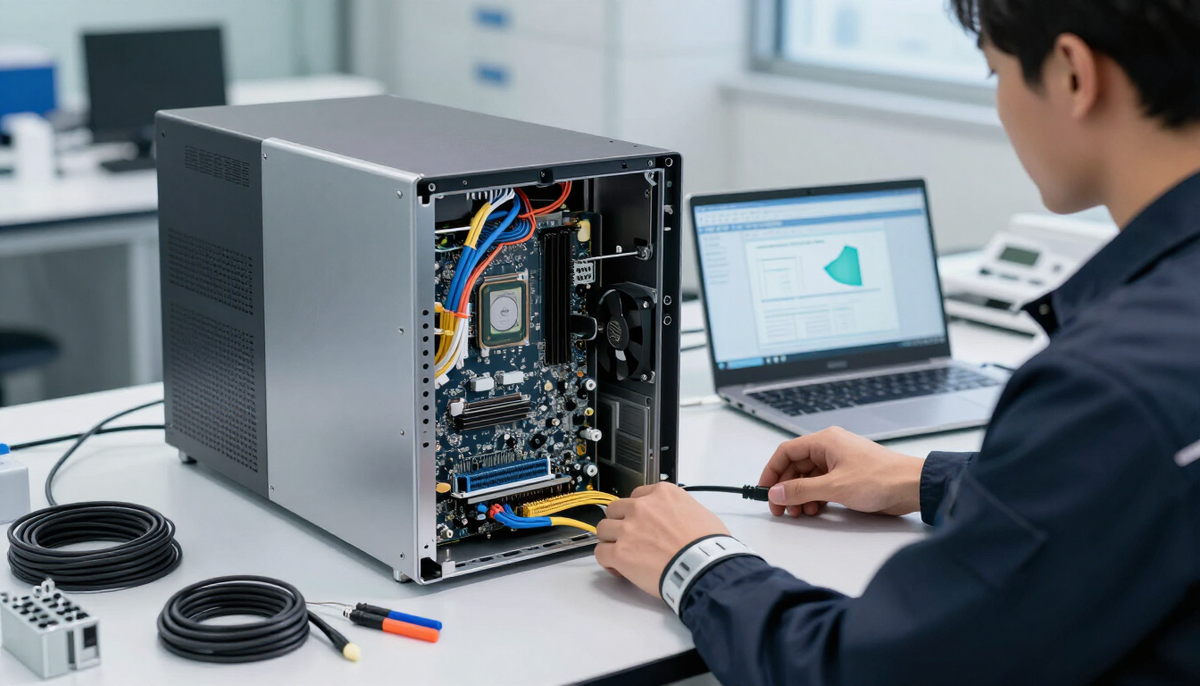
The most common cases in high-value hardware are easy to recognise. A vendor ships two GPU servers to a prospect for a four-week proof of concept. A manufacturer sends a demo rack of switches and an all-flash array to a technology fair. A field engineer travels with test instruments and spare line cards to commission a network. A customer returns a faulty storage controller to the factory and receives a loan unit while it is repaired. A research lab borrows an accelerator board for a benchmark.
What these cases share is a real, provable intention to bring the goods back out. Customs in all five markets asks the same questions: what is the equipment, why is it here, how long will it stay, and who pays if it does not leave?
What does not qualify is just as important. Goods imported for sale, or sent "on approval" so the customer can decide whether to buy them, generally fall outside temporary regimes. The same applies to equipment that will be modified, integrated into a larger system or consumed. A server that arrives for a demo and then stays because the customer liked it has changed status, and that change needs a proper import, with duties, taxes and product compliance, before the equipment is handed over.
Which temporary import route fits each destination?
Each market has its own national regime, and the ATA Carnet only works where the destination accepts it for your type of goods. The United States and the European Union accept carnets for commercial samples and professional equipment; Brazil has its own carnet rules; Argentina and Uruguay are best handled through their national temporary admission regimes.
The table below summarises the main route in each destination as a starting point for planning; always confirm the specific equipment and purpose before shipping.
| Destination | Main temporary regime | ATA Carnet | Time limit | Duties and taxes during the stay | Who files the entry |
|---|---|---|---|---|---|
| United States | Temporary Importation under Bond (TIB), HTSUS Chapter 98, Subchapter XIII | Accepted for commercial samples and professional equipment | 1 year, extendable up to 3 years in total | Suspended against a bond, generally twice the estimated duties | The importer of record: the owner, a nonresident importer with a bond, or an IOR |
| European Union | Temporary admission, Union Customs Code Articles 250 to 253 | Accepted in all member states | As a rule, up to 24 months | Total relief, or partial relief at 3% of the duty per month plus import VAT | Holder normally established outside the EU, usually through a customs representative |
| Brazil | Admissão temporária, with total suspension or for economic use | Regulated by Normative Instruction RFB No. 2,036/2021 | Set per case; up to 100 months for economic use | Suspended, or 1% per month of federal taxes for economic use | A beneficiary enabled in Siscomex (Radar) |
| Argentina | Importación temporaria, Código Aduanero Article 250 | Not on USCIB's list of accepting countries | Set by customs for each authorisation | Suspended against a guarantee | An importer registered with ARCA, through a licensed customs broker |
| Uruguay | Admisión temporaria para reexportación en el mismo estado, CAROU Article 81 | Not on USCIB's list of accepting countries | Set by the Ministry of Economy and Finance | Suspended, except for fees | Through a licensed customs broker (despachante de aduana) |
Two patterns stand out. In the United States and the European Union, a foreign company can often hold the temporary import itself, with the right bond or representative. In the three South American markets, a local party almost always has to appear on the declaration, which is where an Importer of Record becomes part of the plan.
Can you use an ATA Carnet for servers and network gear?
Yes, in the countries that accept it and for the right purpose. An ATA Carnet is an international customs document that covers commercial samples, professional equipment and goods for exhibitions and fairs, valid for one year. It does not cover goods for sale or equipment that will be put to commercial use for a customer.
The carnet works like a passport for the goods. It lists every item with its description, serial number, value and origin, and customs stamps it on each entry and exit. Because a national guaranteeing association stands behind it, the holder does not post a separate bond in each country. In the United States, the United States Council for International Business (USCIB) is that association, and it issues carnets through appointed service providers.
For a sales engineer who travels to three EU member states and the United States with the same demo kit, a carnet is often the fastest option. It is prepared once, at home, before departure, and it saves a customs entry with a guarantee at every border. US Customs and Border Protection publishes its guidance on ATA Carnets for temporary imports, including what qualifies and how to extend a carnet beyond its first year.
The limits are just as clear. Personal-use items and consumables cannot travel on a carnet, and goods intended for sale must go through a regular entry. A GPU server that will run a paid pilot for a customer is closer to commercial use than to "professional equipment" carried by the vendor's own engineer, and customs may see it that way. And a carnet is only as good as the destination's acceptance: Argentina does not appear on USCIB's list of countries that accept carnets, and neither does Uruguay. Brazil regulates carnet operations under Normative Instruction RFB No. 2,036/2021, but acceptance depends on the category of goods, so confirm it before the equipment ships.
How does temporary importation work in the United States?
The United States offers two routes: the ATA Carnet and Temporary Importation under Bond (TIB). Under TIB, eligible goods enter free of duty for up to one year, extendable twice for a maximum of three years, as long as the importer posts a bond and re-exports or destroys the goods under customs control.
TIB is set out in HTSUS Chapter 98, Subchapter XIII, and in 19 CFR 10.31 and the following sections. The categories that matter most for IT hardware are articles for testing or experimental purposes, articles imported for repair or alteration, samples used only to take orders, and professional equipment brought in by a nonresident. The goods cannot be imported for sale or for sale on approval.
The bond is generally twice the estimated duties and fees, and 110% for order-taking samples and professional equipment. The higher the duty rate on the equipment, the larger the bond on a rack of servers, and if the equipment is not exported in time, customs demands liquidated damages, generally equal to twice the estimated duties. Extensions are requested on CBP Form 3173 before the period runs out.
Someone still has to act as importer of record on the TIB entry. A foreign company can do that itself as a nonresident importer with a customs bond and, for corporations, a resident agent. Many vendors prefer to use an IOR so that the temporary entry, the later conversion to a permanent import if the customer buys the unit, and any FCC questions are handled by the same party. Our guide to the Importer of Record USA explains how that setup works.
What does EU temporary admission require for IT hardware?
EU temporary admission lets non-Union goods stay in the customs territory, as a rule for up to 24 months, with total or partial relief from import duty. The holder of the procedure is normally established outside the EU, the goods must be identifiable and must not be changed, and customs usually asks for a guarantee.
The legal basis is Regulation (EU) No 952/2013, the Union Customs Code, in Articles 250 to 253, with the detailed cases in Delegated Regulation (EU) 2015/2446. One condition surprises many companies: Article 250 says the holder of the procedure is established outside the customs territory of the Union, unless otherwise provided. In other words, this is one of the few EU procedures designed for a non-EU company, which is why it is a natural fit for a vendor's demo or test equipment.
Total relief applies to specific categories, such as professional equipment, goods for exhibitions and fairs, and certain test or demonstration goods, each with its own conditions. When goods do not meet the conditions for total relief, partial relief may apply: the holder pays 3% of the import duty that would otherwise be due, for each month or part of a month, and import VAT becomes payable. For equipment that will work in a customer's data center for months, that calculation often shows that a normal import, with VAT recovered by a registered party, is cheaper and simpler.
Practical details decide the outcome. The equipment needs a declaration on arrival, a guarantee for the suspended duties and taxes, and a record of serial numbers so customs can match what enters with what leaves. If the hardware has radio functions, CE conformity still matters when it is used in the EU. A non-EU company usually works through a customs representative, and our guide on importing into the EU without an EU entity covers EORI numbers, representation and VAT in more detail.
How do Brazil, Argentina and Uruguay handle temporary imports?
All three have a national temporary admission regime that suspends duties and taxes for goods that will be re-exported. All three also expect a locally registered party, a guarantee or a licensed customs broker on the declaration, so a foreign vendor rarely files alone.
Brazil
Brazil's admissão temporária has two forms. Under total suspension, goods such as test equipment, fair exhibits or tools for a service stay in the country with federal import taxes suspended. Under admissão temporária para utilização econômica, used when the equipment produces revenue in Brazil, for example under a lease or a service contract, the importer pays 1% of the federal taxes per month of stay, and the regime can last up to 100 months including extensions. The rules are in Normative Instruction RFB No. 1,600/2015.
The declaration is registered by a beneficiary enabled in Siscomex, the Radar habilitation, which a foreign company cannot obtain without a Brazilian entity. Suspended taxes are documented in a term of responsibility, and a guarantee may be required depending on the amount and the beneficiary. Product compliance does not disappear because the import is temporary: Wi-Fi, cellular or other radio functions can still raise Anatel questions, as our guide to telecom equipment homologation explains.
Argentina
Argentina's Código Aduanero defines importación temporaria in Article 250 as the regime under which goods may remain in the country for a specific purpose and period, with the obligation to re-export them before the period ends. Customs sets the term in each authorisation and normally asks for a guarantee covering the suspended duties and taxes.
The importer must be registered with ARCA, the federal tax and customs agency, and the declaration goes through a licensed customs broker. A foreign vendor sending a demo rack or test units therefore needs a local importer, and an Argentine customs broker that handles temporary admissions, in place before the cargo leaves. Telecom equipment may also raise ENACOM questions under the homologation regime in force since 2026, depending on how it will be used during its stay.
Uruguay
Uruguay's Customs Code (CAROU, Law No. 19,276) regulates admisión temporaria para reexportación en el mismo estado in Article 81. While the regime lasts, the goods do not pay the taxes on a definitive import, except for fees, and the Ministry of Economy and Finance sets terms and conditions. Clearance goes through a licensed customs broker. For equipment that serves the wider region, a free trade zone can be a better base than a temporary import into the customs territory, because goods in a free zone are outside the customs territory for as long as they stay there.
What happens if the equipment stays or gets sold?
If temporarily imported equipment is sold, kept or not re-exported in time, the suspended duties and taxes become payable, often with penalties or bond claims on top. The clean way out is to close the temporary regime properly, either by re-exporting the goods or by converting the entry into a definitive import before the deadline.
This is how a successful demo turns into a compliance problem: the customer wants to keep the GPU servers, the invoice goes out, and nobody tells customs. In the United States, the bond can be claimed as liquidated damages. In the European Union, the customs debt arises with the duties and VAT that were suspended. In Brazil and Argentina, fines on top of the taxes are common, and in all five markets the goods may need product approvals that were never obtained for a permanent import.
A few habits prevent most of these problems:
- Record serial numbers, photos and a detailed packing list on entry, so the exit can be matched unit by unit.
- Put the re-export deadline in the project plan and the contract, with an owner, not only in the customs file.
- Decide in advance what happens if the customer wants to buy: who will be the importer, who pays the duties and taxes, and who handles homologation.
- Keep the exit documents, such as the stamped carnet, the export declaration or the certificate of destruction, for as long as customs can audit the entry.

Where does an Importer of Record fit in a temporary import?
An Importer of Record takes the legal role on the declaration when your company cannot, or prefers not to. In a temporary import, that means filing the entry, arranging the bond or guarantee, tracking the deadline and, if the plan changes, converting the equipment into a definitive import without a gap in compliance.
The value is greatest where the local rules close the door to foreign companies, as in Brazil and Argentina, and in projects that mix several regimes. A typical example is a vendor that sends a proof-of-concept cluster to a customer in São Paulo, a demo rack to a fair in Frankfurt and loan units to a partner in Buenos Aires in the same quarter. Each shipment needs a different route, a different guarantee and a different exit plan. A single Importer of Record for temporary imports keeps those routes consistent and makes sure nobody discovers a missed deadline when the bond is claimed.
An IOR is also the bridge when the demo becomes a sale, because the definitive import can be prepared alongside the temporary entry.
If you are planning a demo, a test, a fair or a repair loop for servers, networking or storage equipment in Argentina, Brazil, the United States, the European Union or Uruguay, tell us what the hardware is, where it is going and how long it needs to stay. The Comex IOR Services team will tell you which temporary route fits, what guarantee to expect and whether an Importer of Record service is the simplest way to get the equipment in and back out on schedule.
Frequently asked questions
What is a temporary import of IT equipment?
It is an entry where servers, network gear or other hardware come into a country for a specific purpose and period, such as a demo, test, trade fair or repair, and must leave again in the same state. Duties and taxes are suspended or reduced while the equipment stays, usually against a bond or guarantee.
Can I use an ATA Carnet to bring demo servers into Argentina or Uruguay?
Neither country appears on USCIB's list of countries that accept ATA Carnets. Demo and test hardware for Argentina or Uruguay normally goes through the national temporary admission regime, with a registered local importer and a licensed customs broker.
How long can equipment stay in the United States under a TIB?
Temporary Importation under Bond allows one year from the date of import, with up to two one-year extensions, for a maximum of three years. The bond is generally twice the estimated duties and fees, or 110% for order-taking samples and professional equipment.
Can a non-EU company hold an EU temporary admission?
Yes. Under Article 250 of the Union Customs Code, the holder of temporary admission is normally established outside the EU. In practice a non-EU company works through a customs representative, provides a guarantee and can keep the goods, as a rule, for up to 24 months.
What happens if the customer decides to keep the demo unit?
The temporary regime has to be closed by converting the entry into a definitive import before the deadline, paying the duties and taxes and meeting any product approvals. Selling the unit without that step can trigger bond claims, the suspended taxes and penalties.
Do I pay import taxes on equipment under temporary admission in Brazil?
Under total suspension, federal import taxes are suspended while the goods stay. When the equipment generates revenue in Brazil, the economic use regime applies and the importer pays 1% of the federal taxes for each month of stay, for up to 100 months.