
Argentina import duties on IT hardware: what servers, switches and storage pay in 2026
By Comex IOR Services · Published · Last updated · 13 min read

In this guide
- What import duties does IT hardware pay in Argentina?
- How is the import duty on servers, switches and storage set?
- Which taxes come on top of the import duty?
- How much does a server shipment really cost at the border?
- Why do perceptions matter so much for foreign sellers?
- What changed in 2026 for IT hardware imports?
- How can you lower Argentina import duties on IT hardware legally?
- Who should be the importer when you have no entity in Argentina?
- Frequently asked questions
Argentina import duties on IT hardware come in layers. The import duty itself depends on the exact NCM line and is often low or zero for servers and storage, but the statistics fee, VAT and tax perceptions added at clearance can lift the cash paid at the border to roughly a third of the customs value.
That gap between the duty rate and the real bill is where most foreign vendors get their Argentine quotes wrong. A sales team hears that servers enter with a low tariff, prices the deal on that number, and then the customer's customs broker sends a liquidation with five or six more lines on it. Some of those lines are true costs. Others are prepayments that only a registered Argentine taxpayer can recover. If the party paying them has no local tax position, they turn into cost as well.
This guide explains how each layer is calculated for servers, GPU systems, switches, routers and storage arrays, what changed in 2026, and how to structure the import so the money you pay at the border is the money you planned for. It assumes you already know the basics of the Importer of Record role; if not, start there.
What import duties does IT hardware pay in Argentina?
Every commercial shipment of IT hardware pays up to five charges at clearance: the extra-zone import duty, the 3% statistics fee, VAT, an additional VAT perception and an income tax perception, plus a provincial gross income perception in most cases. Only the first two are pure costs. The rest depend on the importer's tax status.
The import duty, known locally as the Derecho de Importación Extrazona (DIE), is the only charge that changes with the product. It applies to goods from outside Mercosur, so hardware made in China, Taiwan, Mexico, the United States or Malaysia pays it, while goods with a valid Mercosur certificate of origin do not. For IT and telecom goods, Argentina does not simply apply the Mercosur Common External Tariff. It keeps a national list of information and telecommunications goods, the BIT list, with its own rates.
The other charges are calculated on top of the customs value and the duty. That stacking effect is why a product with a 0% duty still costs real money to clear, and why the duty rate alone tells you very little about the final landed cost.
| Charge at clearance | Typical rate | Calculated on | Who can recover it |
|---|---|---|---|
| Import duty (DIE) | Set per NCM line in the BIT list; many server and storage lines at or near 0% | Customs value (CIF) | Nobody: it is a cost |
| Statistics fee (tasa de estadística) | 3%, with caps by value bracket | Customs value | Nobody: it is a cost |
| VAT (IVA) | 10.5% for many IT goods, 21% for others | CIF + duty + statistics fee | A VAT-registered Argentine importer, as a credit |
| Additional VAT perception | 10% or 20%, following the VAT rate | Same base as VAT | A VAT-registered importer, against its VAT return |
| Income tax perception | 6% in the general case | Same base as VAT | An importer that files Argentine income tax |
| Gross income perception (IIBB) | Varies by province, often around 2.5% | Same base as VAT | An importer registered for provincial gross income tax |
How is the import duty on servers, switches and storage set?
The duty comes from the 8-digit NCM code declared on the import entry and the rate assigned to that code in Argentina's tariff decree. For IT hardware, the relevant schedule is Annex IV of Decreto 557/2023, the BIT annex, so the right classification decides the rate.
Argentina's current tariff framework is set by Decreto 557/2023, which adopted the Mercosur nomenclature aligned with the seventh amendment of the Harmonized System. Its Article 4 fixes the duty for the goods listed in Annex IV, the information and telecommunications goods. Mercosur Common Market Council Decision 8/21 authorizes Argentina to apply rates different from the Common External Tariff to these goods until 31 December 2028, which is why the Argentine rate for a server can differ from the rate Brazil or Uruguay applies to the same box. You can check the import duty rates set by Decreto 557/2023 and the list of decrees that have amended them since.
That list of amendments matters. The BIT rates move by decree, and they have moved in both directions. Decreto 117/2017 cut the duty on the 8471.50 lines, where most servers sit, and on the 8471.70 storage units to zero. Decreto 136/2023, by contrast, raised the duty on several portable computer lines under 8471.30 from 0% to 16%. More recently, Decreto 333/2025 brought smartphones down to 0% from 15 January 2026, a reminder that the government uses these annexes actively.
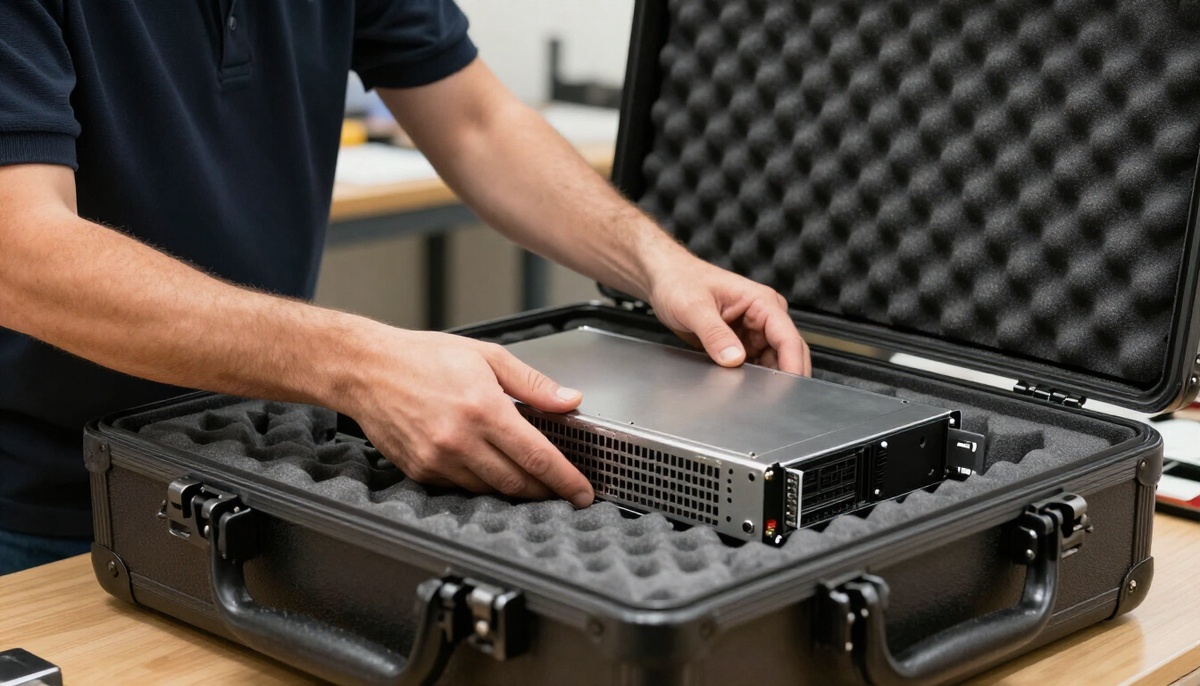
For a buyer, the practical consequence is simple: there is no single Argentine rate for "IT hardware". A rack server, a GPU accelerator card shipped loose, a top-of-rack switch, a storage expansion shelf and a set of optical transceivers can fall into different subheadings with different duties. Classification also depends on how the goods travel. A complete GPU server is classified as an automatic data processing machine, while the same accelerators shipped as spare parts may go to a parts heading. Our guide to the HS code for servers walks through those choices line by line.
Which taxes come on top of the import duty?
On top of the duty, Argentine customs collects the statistics fee, VAT and three perceptions at the same time, all before the goods are released. For most IT shipments these taxes, not the duty, are the largest part of the cash paid at clearance.
The statistics fee is 3% of the customs value. Decreto 1140/2024 extended it until 31 December 2027 and kept maximum amounts by value bracket, so on a large shipment the fee is capped rather than growing indefinitely. On a lot declared at 100,000 US dollars, for example, the fee and the cap for that bracket meet at 3,000 dollars.
VAT is charged at clearance on a base that adds the customs value, the duty and the statistics fee. Many IT and telecom goods qualify for the reduced 10.5% rate, while others pay the general 21%, again depending on the NCM line. Customs then adds an additional VAT perception under Resolución General 2937, an advance payment of the importer's future VAT, at 10% when the goods carry the reduced rate and 20% when they carry the general one.
The income tax perception works the same way. Under Resolución General 2281, as amended by Resolución General 4579/2019, customs collects 6% of the same base in the general case, rising to 11% for goods imported for the importer's personal use or consumption. Most provinces also apply a gross income tax perception through the customs system, usually in the low single digits.
Two items that used to appear on Argentine liquidations should no longer be there. The PAIS tax on foreign currency purchases expired at the end of 2024, so it is no longer part of an import's cost. And internal taxes, the impuestos internos, only reach specific electronics: Decreto 333/2025 set them at 9.5% for imported monitors, televisions and some phones, but they do not apply to servers, switches or storage.
How much does a server shipment really cost at the border?
On a typical shipment of servers declared at 100,000 US dollars, with a 0% duty line and the reduced VAT rate, the importer pays around 33,000 dollars at clearance. Only about 3,000 of that is a definitive cost if the importer can credit the rest.
Here is how the numbers stack up, assuming a zero-duty server line, 10.5% VAT and a 2.5% provincial perception. The figures are illustrative; your NCM line, province and tax status will change them.
The customs value of 100,000 dollars carries no duty, so the statistics fee of 3,000 dollars brings the tax base to 103,000. VAT at 10.5% on that base is 10,815 dollars. The additional VAT perception at 10% adds 10,300, the income tax perception at 6% adds 6,180, and the provincial perception at 2.5% adds 2,575. The total collected at clearance is 32,870 dollars, before the customs broker's fees, storage at the terminal and local freight.
For an Argentine company that is registered for VAT, income tax and gross income tax, roughly 29,870 dollars of that total comes back as tax credits over the following months. For a foreign vendor shipping DDP with no Argentine tax registration, none of it comes back. That difference, close to 30% of the shipment value, is the most common reason Argentine deals lose their margin after the purchase order is signed.
If you want to model a specific project before quoting, our sister operation ComexAR prepares a landed-cost study for Argentine imports that runs the exact NCM lines, the destination province and the financing cost of the perceptions.
Why do perceptions matter so much for foreign sellers?
Perceptions are advance payments of Argentine taxes, so their value depends entirely on whether the importer can offset them. A registered local importer recovers them as credits; an importer with no Argentine tax filings simply loses them.
This is the point that separates a workable Argentine import from an expensive one. The duty and the statistics fee are the same for everyone. The VAT and the three perceptions are only neutral when the importer of record is an Argentine taxpayer with enough taxable activity to absorb the credits. Even then, they cost money while they wait: a company that pays 30,000 dollars in perceptions in November and recovers them over the next few months is financing the Argentine treasury in the meantime.
There are partial reliefs. Resolución General 5868/2026 extended until 31 December 2026 the exclusions from the VAT and income tax perception regimes that apply to certain essential goods and to production inputs imported by small and medium companies holding the MiPyME certificate. Large data center operators and integrators rarely qualify, so most high-value server imports still pay the full perceptions.
The structural answer is to make sure the importer of record is the party that can use the credits. When your Argentine customer is a solid local company, letting it import may be the cheapest route. When it is not, or when you need to control the timeline yourself, a local Importer of Record in Argentina with an active tax position carries the perceptions within its own filings.
What changed in 2026 for IT hardware imports?
The duty rates for most servers and storage did not change in 2026, but the surrounding rules did: perception exclusions were extended, the statistics fee remains in place until 2027, phones reached 0% duty and ENACOM's new equipment registration regime starts on 1 December 2026.
For hardware buyers, the ENACOM change is the one to watch. From 1 December 2026, radio and telecom equipment needs a registration under ENACOM's new RAMATEL rules to clear customs, which affects Wi-Fi access points, routers with radio modules and 5G equipment. It does not change the duty, but a missing registration holds the goods in the customs zone while storage charges accumulate.
Tariff policy itself keeps moving. Decreto 311/2026, published on 4 May 2026, rewrote Argentina's national list of exceptions to the Common External Tariff and created a temporary list of up to 50 NCM codes valid until 31 December 2028. Several other decrees have amended Decreto 557/2023 since 2024. None of this means your server line has changed, but it does mean a rate quoted from a spreadsheet built two years ago should be checked against the current annex before it goes into a contract.
How can you lower Argentina import duties on IT hardware legally?
The legal levers are correct classification, the right import regime and the right importer. Classification fixes the duty, special regimes can remove it, and choosing an importer that can credit VAT and perceptions removes most of the remaining cash cost.
Start with classification. A shipment declared under a generic heading often lands on a higher rate than the one the goods actually qualify for, and an aggressive classification that customs later rejects brings fines under the Customs Code. Getting the NCM line right, with technical documentation that supports it, is the single most effective way to keep the duty where it belongs.
Next, look at the regime. Large data center projects approved under the Régimen de Incentivo para Grandes Inversiones can import capital goods free of import duty, a case we cover in our guide to RIGI data center imports. Equipment that only enters for a trial, an event or a repair can use temporary admission and leave again without paying definitive duties. Refurbished servers can be imported as used goods, but they are declared and valued differently and should be quoted separately.
Finally, look at the shipment itself. Splitting a project into many small lots to stay under the courier regime limit does not work for commercial quantities of servers and risks reclassification. Consolidating shipments, on the other hand, can reduce fixed costs such as broker fees and terminal handling per unit, and timing the import so perceptions are credited against a period with enough taxable sales reduces the financing cost.
Who should be the importer when you have no entity in Argentina?
The importer should be a registered Argentine company that can file the entry, carry the liability and use the VAT and perception credits. Without a local entity, that means your customer, a distributor, a subsidiary or an Importer of Record.
Each option shifts the duties and taxes to a different balance sheet. A customer importing directly takes on the whole liquidation, which works when it has the tax capacity and the experience. A distributor adds a margin but absorbs the perceptions in its own business. A subsidiary gives you control, but setting one up and registering it as an importer takes months. An Importer of Record lets a foreign seller deliver into Argentina on a set timeline, with the duty, statistics fee and taxes paid by a local importer that can account for them.
Whatever route you choose, decide it before you quote. The difference between a landed cost built on the duty rate alone and one built on the full liquidation is too large to absorb afterwards.
If you are preparing a quote for servers, GPU systems, network equipment or storage going into Argentina, Comex IOR Services can review the NCM lines, estimate the full liquidation and act as your importer so the credits are not lost. Tell us what you are shipping through our Importer of Record services for Argentina and we will come back with a clear picture of what the import will cost and how long it will take.
Frequently asked questions
Do servers pay import duty in Argentina?
It depends on the 8-digit NCM line. Servers and storage fall under Argentina's list of information and telecommunications goods in Annex IV of Decreto 557/2023, where many lines carry 0% or a low rate, while some portable computer lines have carried 16% since Decreto 136/2023. Check the current annex before quoting.
What VAT rate applies to IT hardware imported into Argentina?
Many IT and telecom goods pay the reduced 10.5% VAT rate and others pay 21%, depending on the NCM line. Customs also collects an additional VAT perception of 10% or 20% on the same base, calculated on the customs value plus duty and statistics fee.
Can a foreign company recover the VAT and perceptions paid at Argentine customs?
Not without an Argentine tax registration. VAT and the VAT, income tax and gross income perceptions are credits for a registered local importer. A foreign seller importing DDP with no local filings loses them, which can add close to 30% to the cost of a shipment.
How much is the statistics fee on imports into Argentina?
It is 3% of the customs value, extended by Decreto 1140/2024 until 31 December 2027, with maximum amounts by value bracket. On a shipment declared at 100,000 US dollars, for example, the fee is 3,000 dollars.
Is the PAIS tax still charged on imports into Argentina?
No. The PAIS tax on foreign currency purchases expired at the end of 2024, so it no longer appears in the cost of importing servers, switches or storage.
Does hardware from Mercosur countries pay Argentine import duty?
Goods that qualify as Mercosur origin and travel with a valid certificate of origin are exempt from the extra-zone import duty. They still pay VAT and the tax perceptions at clearance. Hardware made in Asia or the United States and shipped through Brazil keeps its original origin and pays duty.